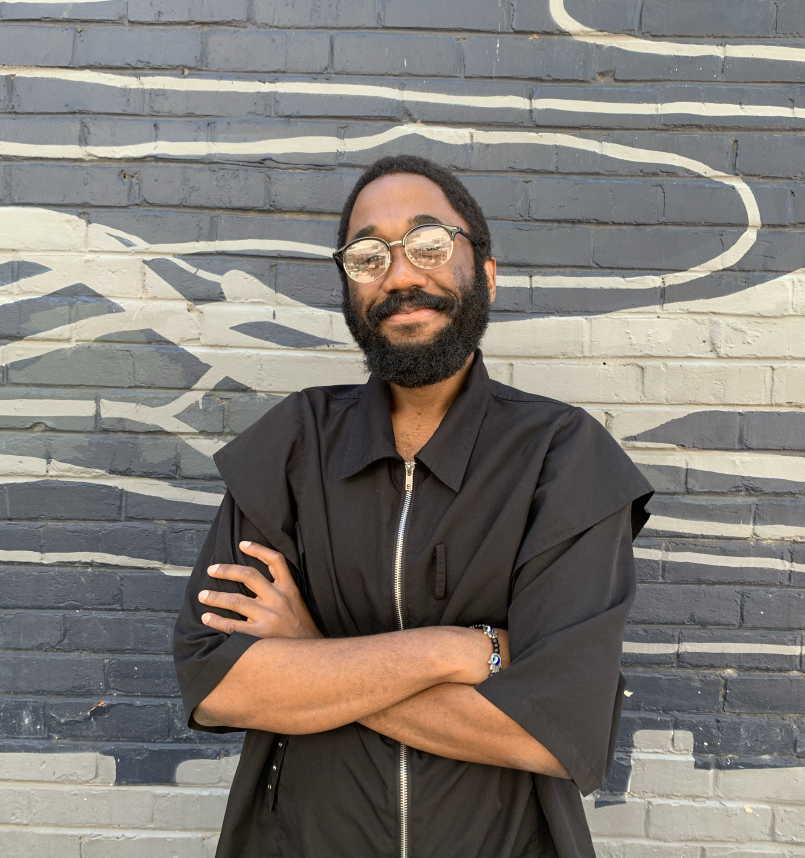

Nick Makoha (FRSL) joins us for this 10th edition of A Short Talk, where the British Ugandan poet chats with 2025 Rajat Neogy Fellow Sihle Ntuli about his latest work, The New Carthaginians. The collection has been nominated for the 2025 T.S. Eliot Prize and the Forward Prize for Best Single Poem. From a thoughtful deep dive into the creative choices behind his new book, it becomes abundantly clear just how devoted Makoha is to craft. The conversation also explores the Obsidian Foundation initiative, his approach to the blank page, and a few words about the impact of Kendrick Lamar’s Mr. Morale & The Big Steppers on him. A truly engaging glimpse into the mind of a poet in his own words.
A LONG HOUSE
Congratulations on the release of The New Carthaginians. I felt the title offers the reader a hint into the direction of the work from a Classical perspective. What first came to my mind was the North African empire of Carthage, one that managed to cross the Alps to challenge the Romans. With this sentiment in mind, what does The New Carthaginians seek to challenge from its title and beyond?
NICK MAKOHA
Thank you. You’re right. The New Carthaginians draws from Classical memory, but it does so to subvert the dominant gaze. Carthage, once a thriving North African empire, is too often remembered solely through its destruction, burnt to the ground by Rome, its knowledge erased, its queen, Dido, recast by Virgil as a lovesick obstacle to imperial destiny. Western literature continued this erasure, from the Aeneid to Shakespeare’s Dido, Queen of Carthage. But I see Carthage not as ruin, but as echo, a lost frequency that still hums through the bones of the diaspora.
In the same way, Uganda and many African nations are often imagined only through their trauma. Amin becomes the shorthand. The complexity of our history, the depth of our culture, the brilliance of our people, all flattened. But The New Carthaginians asks: What if we resist that narrative? What if we don’t enter history through the wreckage, but through the archive of what endures, our myths, our art, our survival?
In The New Carthaginians, there are three New Carthaginians: the Poet (myself), a Black Icarus, and a resurrected Jean Michel Basquiat. By naming all three as “New Carthaginians,” I reclaim how Carthage has been read in Western literature as a site of ruin, defeat, and malevolence in works like Virgil’s Aeneid or Shakespeare’s Dido, Queen of Carthage. I invert that and recast Carthage not as a corpse in the canon, but as a myth we still live in.
The resurrected Basquiat stands in for the creative and revolutionary force of Black art, a spirit that refuses erasure. The Black Icarus embodies the danger, ambition, and longing of flight, not in hubris but in hunger for light. The Poet is the witness, the medium, the one trying to stitch together myth, memory, and possibility. In aligning all three under one name, Carthaginian, the book argues we are not defined by what was destroyed but by what we can reimagine, reclaim, and recreate.
A LONG HOUSE
I was particularly taken by the way you’ve chosen to structure The New Carthaginians. A work that is intentionally non-linear, where fragments form collages alongside figures like Jean Michel Basquiat, a Black Icarus, and the poet via CODEX© against a backdrop of the 1976 Air France Hijacking and the subsequent raid in Entebbe, Uganda. Could you talk us through the structuring process and what informed your decision to present the collection in the way that you did?
NICK MAKOHA
Thank you for your thoughtful question. Each poem in The New Carthaginians is a painting, but the book itself is a mural structured as a triptych, divided into three sections, each offering a distinct yet interconnected narrative:
The Deep Space Quartet – A non-linear retelling of the Carthaginian myth, reimagined through the lens of migration and diaspora, centred around three key figures: the poet, a resurrected Basquiat, and a Black contemporary Icarus who did not fly too close to the sun. In this sequence, I introduce a new form I call the “footnote poem,” where footnotes are integrated into the main text, creating a layered reading experience that challenges traditional narrative structures. This form invites readers to engage with the text in a more interactive and interpretive way, rooted in the Afro-surreal experience of Black consciousness.
The CODEX© – A ghost narrative of the poet, presented as a series of loose sonnets that blur the boundaries between footnotes and main text.
Eroica – Following Basquiat’s diptych of the same name, this section is a Basquiat-inspired version of the Entebbe hijacking, exploring themes of flight, fall, and transformation.
This structure mirrors Basquiat’s “exploded collage” technique, where disparate elements words, images, fragments are layered to create a dynamic whole. In The New Carthaginians, this approach allows multiple narratives and voices to coexist, reflecting the complexity of identity and history. By structuring the collection this way, I aim to create a multifaceted exploration of identity, memory, and transformation, encouraging readers to experience the narratives from different perspectives and to find connections between seemingly disparate elements.
A LONG HOUSE
Migration is a core concern of the collection, particularly the migration you experienced as a boy when you and your family fled Uganda to escape Idi Amin’s regime. How has this affected your identity as a Ugandan, and how has your poetry examined that?
NICK MAKOHA
Migration is central to The New Carthaginians because it is not just a physical journey but a shaping force of identity, memory, and belonging. Fleeing Uganda as a boy to escape Idi Amin’s brutal regime meant carrying both the trauma of rupture and the resilience of survival. This experience imprinted on me a complex sense of what it means to be Ugandan not simply tied to geography, but to history, culture, and inherited memory that travels across borders.
My poetry explores this layered identity by resisting the reduction of Uganda to its moments of trauma, instead excavating the richness beneath: the myths, the diasporic connections, and the ongoing conversation between past and present. Through language, I seek to reclaim a narrative that is expansive and that holds both loss and possibility a way to make visible the ways migration fractures and also creates new forms of belonging.
Rendering a contemporary African story is vital in today’s climate because it challenges outdated and often negative stereotypes. It offers a fuller, more nuanced understanding of Africa and its people. This storytelling pushes back against the dominant narratives that too often focus on violence, poverty, or instability, and instead presents Africa as vibrant, complex, and forward-looking. It is an act of reclaiming agency and ensuring that African voices shape their own stories in the global conversation. In this sense, migration is not just about displacement but about transformation, and poetry becomes the space where that transformation can be witnessed and made whole.
A LONG HOUSE
You’ve built platforms like The Obsidian Foundation, which does some amazing things for marginalized and diasporic voices alike. What does literary stewardship look like to you—and what is most important in creating a home and support for black poets?
NICK MAKOHA
Thank you, I appreciate that. For me, literary stewardship means creating structures that outlive you, that continue to nurture others even when you’re not in the room. The Obsidian Foundation was born out of a desire to offer what I wish I’d had at the beginning of my journey: a space that understands not just the craft of writing, but also the cultural and emotional contexts Black poets carry with them.
I was fortunate to be shaped by communities like Cave Canem, The Complete Works, and Malika’s Poetry Kitchen. These spaces centred mentorship, critical feedback, and a shared commitment to craft. They didn’t just help me become a better writer; they gave me the courage to write from the full range of my experience.
Craft is central to everything we do at Obsidian. A poem has to work on the page, but it also has to carry the truth of the voice behind it. Creating a home for Black poets means making space for complexity, where writers can be vulnerable, political, experimental, joyful, or angry, and know they’ll be seen and heard. Ultimately, it’s about building trust and offering continuity. The most important thing is making sure the next generation of Black poets has what we had and more.
A LONG HOUSE
Outside of poetry, what other work of art, be it a musical album, television series, film or exhibition, has recently moved you? Why has it resonated with you so much?
NICK MAKOHA
Outside of poetry, Kendrick Lamar’s Mr. Morale & the Big Steppers has had a profound impact on me. It’s a project I’ve returned to many times, often listening to it in full while doing everyday things like running errands, tuning a poem, or moving through the city. Even in those moments of routine, it demanded my attention. I saw Kendrick perform the album live twice, and each time felt like witnessing an art installation, vulnerable, explosive, and precise.
One line from N95 that really stays with me is:
“You’re worried about a critic that ain’t protocol.”
That hits hard. It’s a reminder to stay rooted in your own voice and truth, especially when speaking from the margins. As someone committed to literary stewardship and building spaces like the Obsidian Foundation for Black poets, the idea of trusting your internal compass over external validation resonates deeply.
That said, I could easily replace Kendrick with Tears for Fears’ music, Ghetts Live: The Power Of The Royal Festival Hall, or the television series Atlanta, which constantly reimagines narrative and form. I’ve also been moved by watching live interviews with Marlon James or Ekow Eshun. The way they think, speak, and reflect on identity, myth, and culture has shaped my own creative process. Each of these encounters offered a different kind of permission to be complex, contradictory, and committed to craft.
Kendrick is a poet in the truest sense. His use of form, cadence, and layered storytelling is masterful. Mr. Morale gave me a kind of permission when writing The New Carthaginians. It helped me explore contradiction, to be both wounded and defiant, and to experiment with structure. It reminded me that the most powerful art doesn’t comfort. It unsettles, it reveals, and it invites us to confront ourselves.
A LONG HOUSE
Talk us through the ways in which you navigate the blank page, when Nick Makoha sits down to write the poem, what is your first move and which among you first few steps do you feel is most vital?
NICK MAKOHA
When I sit before the blank page, I don’t see emptiness, I see a space charged with possibility, like a magnetic field humming with invisible energy. The page is both a canvas and a force pulling at my words, my thoughts, my silences. It’s alive, a living surface that resists and invites simultaneously.
My first move is to enter that field with openness to feel the pull of the poem before I even know what it wants to be. I might begin with a single image, a fragment of sound, or a sudden flash like a spark caught between the real and the surreal, the seen and the unseen. It’s a dance with gravity and magnetism, where words orbit, collide, and align into new constellations.
The most vital step is surrendering to that invisible force, letting the page guide me rather than trying to force it. I treat it as an alchemical space where meaning emerges in strange and unexpected ways. Like Basquiat’s explosive collages, my writing is a layering of fragments, raw, vibrant, chaotic harmony. I strive to be a poet who paints with words as brushstrokes, the page both canvas and magnetic field, alive with the electric dance between my mind, my history, and the pulse of the world beneath my skin.
A LONG HOUSE
Through your extraordinary journey as a poet, one that is respected the world over, what do you still dream about achieving? Do you think the artist can ever find peace once their dreams are fulfilled or is it a never-ending process of re-dreaming?
NICK MAKOHA
First, I want to gently challenge the idea that I’ve “arrived.” The notion of arrival implies completion, a linear journey with a beginning, middle, and triumphant end. But for a Black poet like myself, whose work is shaped by histories of exile, rupture, and refusal, the journey is not so tidy.
I don’t dream of “achieving” in the way the world often frames it. I dream of conditions, of environments where Black poets are not exceptionalised, not extracted from, but held, sustained, and heard without translation. I dream of quiet rooms where we don’t have to explain ourselves. I dream of not being first or only.
As for peace, I don’t know if peace is found after dreams, or if it lives in the spaces where dreaming is allowed to happen. Peace, for me, is less a destination and more a practice. It’s in the line that surprises me, in the moment the poem pulls me somewhere I didn’t expect to go. It’s in finding language that resists containment.
If anything, I’ve learned that the work of the artist is not to arrive but to remain porous. To reimagine, to return, to make space for what hasn’t yet been spoken. Not a redreaming out of restlessness, but a redreaming as survival. As care. As listening.