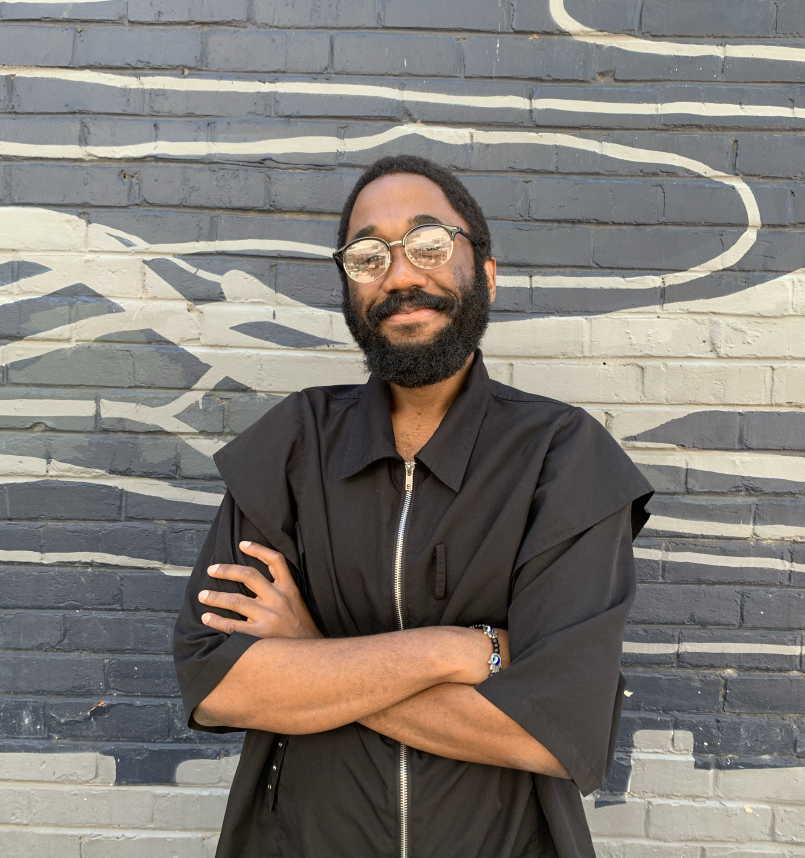

In this 9th edition of, A Short Talk, 2025 Rajat Neogy Editorial Fellow Sihle Ntuli is joined by the British Trinidadian poet, performer and mentor Roger Robinson (FRSL). His most recent collection ‘A Portable Paradise’ won the T.S Elliot Prize in 2019 and the Royal Society of Literature Ondaatje Prize in 2020, with Robinson going on to be elected Fellow of the Royal Society of Literature (FRSL) also in 2020. Their conversation touches on the black British lived experience, diasporic memory and the undercurrents of creative practice and community building. Join us in this engaging and spiritually resonant dialogue, done as a brief but deeply insightful meditation on a storied career.
A LONG HOUSE
Your critically acclaimed collection A Portable Paradise is your most recent poetry book release. The words within it not only shimmer but, coupled with a sense of public urgency, also illuminate a private emotional resonance for its readers. Looking back now, what did you hope the poems would reveal about the emotional and political hunger of that time?
ROGER ROBINSON
At the time, there was a slew of negative events affecting Black British communities. I definitely felt a level of responsibility as a Black British writer to address them. But more than that, those incidents brought up a deep emotional pain within me that needed to be examined and made sense of through writing. At the same time, the mainstream media was doing a horrible job of covering these stories, and I felt I had access to much richer emotional and spiritual material than they were willing to engage with or show.
A LONG HOUSE
Through your ventures into music, what has been the most significant contribution of music to the composition of your poetry, and vice versa?
ROGER ROBINSON
Music has helped me understand the musicality of words, the vowel sounds, the way words scan, assonance, consonance, and so on. And poetry, in turn, has allowed me to find epiphanic moments in songs and to let lyrics lead the song, rather than being led by melody.
A LONG HOUSE
Talk to us about your work with Malika’s Poetry Kitchen and the importance of working with and as part of a community. What benefits have you found in forming a writers’ collective?
ROGER ROBINSON
Much of the progress made by Black British writers has come through the kindness and mentorship of other diasporic writers. Writing can be a lonely endeavour, and there is always strength in unity. Collectivity can also shift power dynamics with the mainstream, often tipping them a little more in our favour.
A LONG HOUSE
Could you highlight a few resources and materials that you’ve been developing over the years, and briefly talk us through the philosophies that guide your pedagogy—particularly in the context of potential learners from diasporic and marginalized backgrounds?
ROGER ROBINSON
I’ve been creating poetry and creativity resources online since 2011, after realizing that marginalized writers were being priced out of access to poetic and creative knowledge. I wanted to make digital resources so that diasporic writers around the world could access them at a reduced cost. I tend to pitch my resources at intermediate writers—those who are ready to move to a more advanced stage. I try to be as concrete as possible and avoid poetic or academic jargon. I also encourage reading as a precursor to writing, as it helps develop one’s poetic voice. And I emphasize that poetry is an essential tool in the practice of empathy.
A LONG HOUSE
How have you managed to retain your Trinidadian roots and heritage while living and working in Britain? Given your background, what are your thoughts on identity in our contemporary world, and how do you approach it in your poetry and your music?
ROGER ROBINSON
My formative years were in Trinidad, but these days I tend to see myself as Black British. I’ve lived longer in England than I have in Trinidad, but I still see England through a Trinidadian lens.
A LONG HOUSE
So how does Roger Robinson unwind away from the world of poetry? Please share one mindful act that helps you return to the work feeling refreshed and reinvigorated.
ROGER ROBINSON
Spending time with my family. Nearly everything else I do links back to writing in some way. If I watch a film, I’m thinking about storytelling; if I go to a concert, I’m thinking about lyrics, and so on.
A LONG HOUSE
In your view, what can be done to strengthen ties between Black British and African poetry? Are there existing barriers that still need to be dismantled, and do you see potential for direct collaboration between the two regions?
ROGER ROBINSON
I think there should be more exchanges between us, both online and in person. There are so many commonalities to explore. From here, it seems the African continent is on the rise, in music, in art, and in rejecting colonial shackles, so I’m excited to see the knock-on effects this might have on its literature.
A LONG HOUSE
As someone many consider a legend of the genre, could you share one of your favourite moments on your poetic journey thus far, and why it meant so much to you?
ROGER ROBINSON
It’s flattering that someone might think of me as a legend, but honestly, I’m so ordinary you wouldn’t believe it. My wife would probably laugh out loud if she heard me called that.
One of my favourite moments on this journey? There have been many, but probably seeing people I’ve mentored go on to get published and win prizes. That’s something I can take real pride in.